





In Motion is our transformative 18-month artist development programme for original music creators at pivotal points in their careers. We support music creators to design and embark on the next chapter of their creative and professional journey, providing the space, personalised support, funding, networks and skills development to realise their ambitions, culminating in a final creative project for public release.
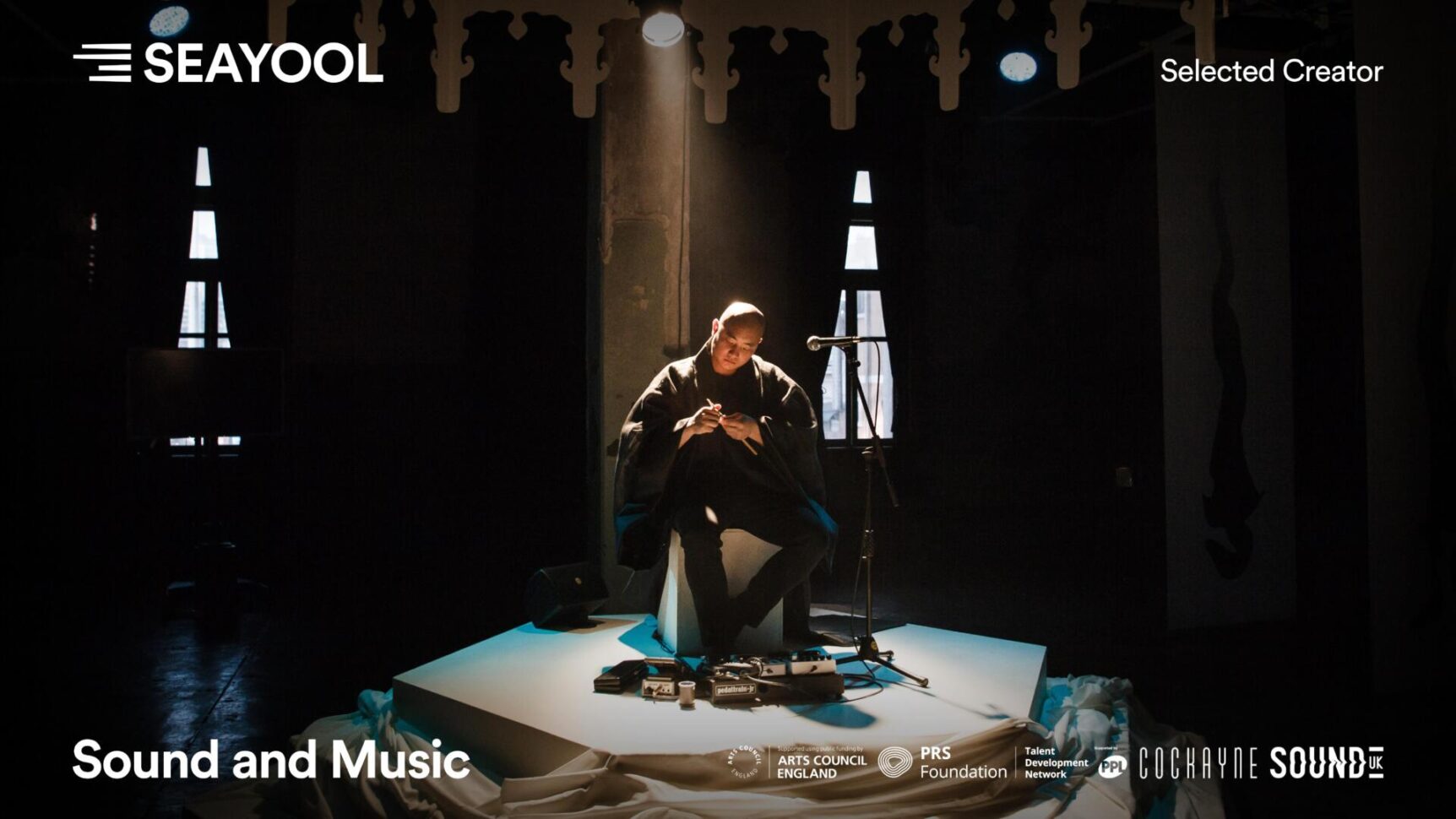
In this Q&A, we speak to In Motion 2026 creator SEAYOOL, a composer and performer, experiments with the ‘expansion of senses’ by traversing between the piri, a traditional Korean instrument, and electronic music. He explores human inner senses by interweaving the piri’s primal expressiveness with digital sounds, transforming breath into electronic waves and classical melodies into experimental rhythms.
On stage, he seamlessly navigates between traditional instruments and cutting-edge technology, guiding audiences into an uncharted sensory realm. SEAYOOL’s live performances, imbued with spontaneity, are groundbreaking experiments. His music encompasses a versatile spectrum, enriched by collaborations with theatre, dance, and exhibitions.
How would you describe your creative process?
My creative process starts from the physical and acoustic properties of the piri. I record and analyse elements such as breath, pitch, and timbre, then translate them into digital signals.
I build systems where these elements control sound processing, visuals, or spatial changes in real time. The focus is on how acoustic performance can extend beyond sound into a broader sensory environment.
I develop ideas through testing in live situations. Improvisation plays an important role, allowing the system to evolve through performance. I then refine structure, timing, and interaction based on these results.
“I develop ideas through testing in live situations. Improvisation plays an important role, allowing the system to evolve through performance. I then refine structure, timing, and interaction based on these results.”
Are there any particular themes, ideas or questions that you find yourself returning to in your work?
I often return to the idea of expanding sensory experience through sound. In particular, I am interested in how music can move beyond listening and become something that engages space, perception, and the body.
Another recurring question in my work is how traditional instruments can exist within contemporary systems. Rather than treating them as fixed cultural objects, I explore how their physical and expressive qualities can be recontextualised through technology.
I am also interested in the relationship between performer and audience. I explore ways in which performance can become a shared system, where sound, presence, and interaction shape the work in real time.
What role does technology or experimentation play in your composition process?
In my work, technology functions both as a tool to expand the composition process and as a structural element. I translate aspects of piri performance—such as breath, pitch, and timbre—into digital signals, and connect them to sound processing, lighting, and video.
In this way, technology does not simply reproduce sound, but reshapes the relationship between performance and its outcome.
Experimentation is a fundamental part of my process. I test different setups, verify them in live situations, and refine the structure and behaviour of the system based on these results.
Has your background, identity or environment influenced your sound or practice in any particular ways?
Both of my parents are artists, which exposed me to creative practices and diverse artistic perspectives from an early age. This environment influenced my approach to sound, improvisation, and experimentation, forming the foundation for combining traditional instruments with contemporary techniques and spatial elements.
“I started making music on traditional Korean instruments, mainly the piri. Performing led me to explore how sound conveys emotion and shapes perception.”
How did you first start making music, and what drew you to composition in particular?
I started making music on traditional Korean instruments, mainly the piri. Performing led me to explore how sound conveys emotion and shapes perception. I moved into composition to create complete sound structures and combine traditional instruments with contemporary techniques, electronics, and spatial elements.
What’s your relationship with improvisation, and how does it shape your work?
Improvisation is central to my practice. It allows me to explore the material in real time, responding to the physicality of the instrument, the acoustic environment, and my own perception of sound.
Even in fully scored pieces, this sense of responsiveness informs how I structure the music—moments of unpredictability, flexibility, and listener engagement are designed into the work.
Through improvisation, I experiment with the boundaries between composed and spontaneous sound, constantly questioning how tradition and contemporary practice can coexist.
What’s a sound you’ve heard recently that fascinated you?
Recently, I was fascinated by the field recordings of Yosi Horikawa. The textures of natural sounds—water flowing, leaves rustling, and subtle mechanical noises—were layered and spatialized in a way that made me rethink how environment can be integrated into composition. It highlighted the potential of unconventional sound sources for structuring musical narratives.
“Through the mentorship and collaborative environment provided by In Motion, I hope to further develop my ideas and push the boundaries of my artistic practice.”
What are you looking forward to most about In Motion?
I am most excited about the opportunity to experiment with new forms of interactive performance that blend traditional Korean instruments with contemporary technology. Through the mentorship and collaborative environment provided by In Motion, I hope to further develop my ideas and push the boundaries of my artistic practice.
Specifically, I aim to create a prototype system that transforms the piri, a traditional Korean wind instrument, into a responsive interface for real-time manipulation of sound, light, and space. By integrating breath, gesture, and acoustic expressiveness with digital processes, I want to design immersive audiovisual experiences that expand the sensory dimensions of live performance.
Moreover, I look forward to engaging with a diverse cohort of artists and exploring interdisciplinary collaborations. I believe this exchange of ideas and practices will enrich my own work and open up new possibilities for artistic innovation.
Ultimately, through In Motion, I hope to lay the groundwork for a new direction in my career – one that bridges traditional music, experimental electronics, and interactive art to create profound sensory experiences for audiences.

Sound and Music is a PRS Foundation Talent Development Network Partner supported by PPL.
In Motion 2026 is made possible with the generous support of Arts Council England. PRS Foundation, The Cockayne Foundation and Sound UK.
Learn more about SEAYOOL
Meet the In Motion 2026 creators
Learn more about In Motion