





In Motion is our transformative 18-month artist development programme for original music creators at pivotal points in their careers. We support music creators to design and embark on the next chapter of their creative and professional journey, providing the space, personalised support, funding, networks and skills development to realise their ambitions, culminating in a final creative project for public release.
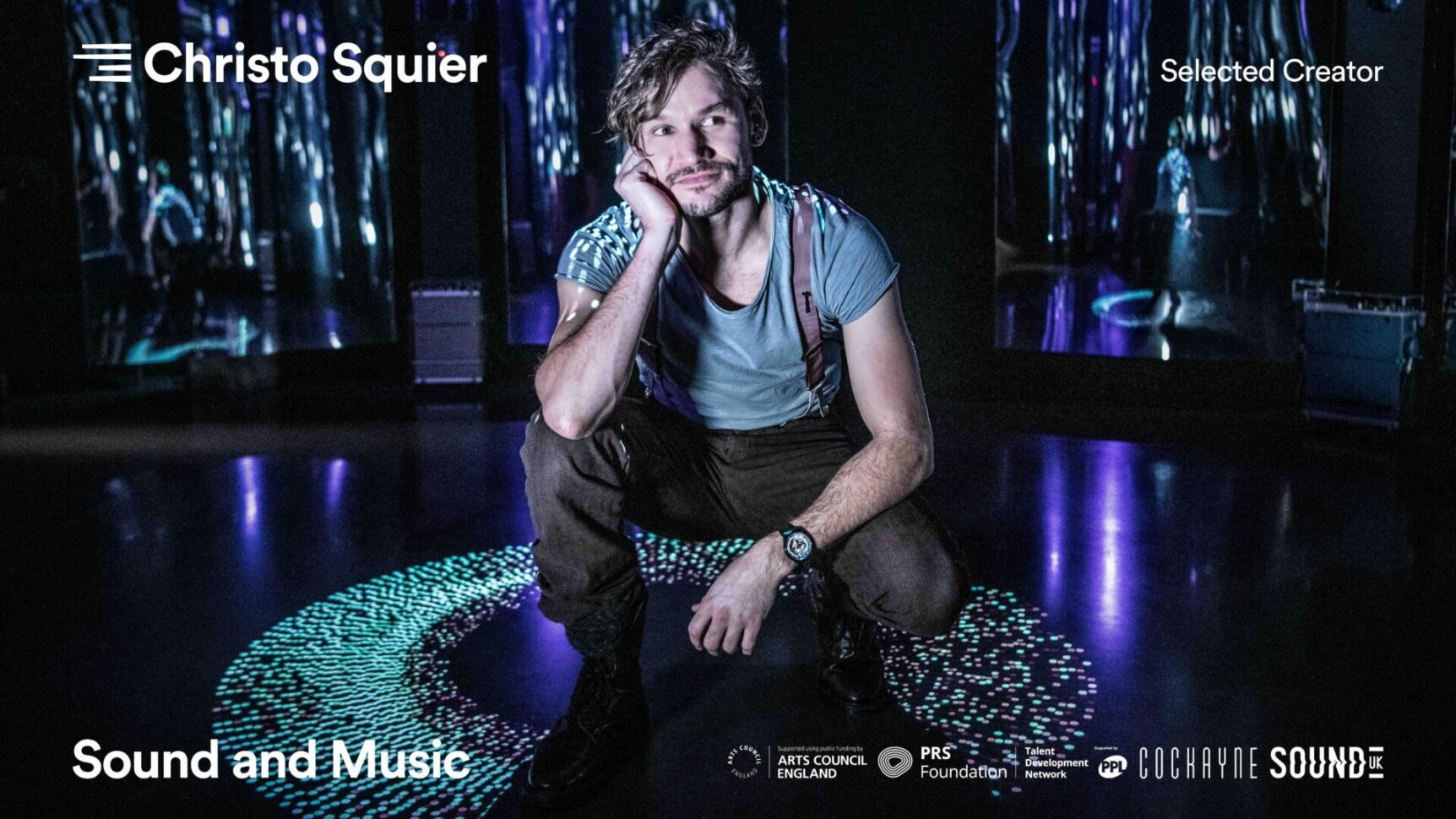
In this Q&A, we speak to In Motion 2026 creator Christo, a composer, installation artist and multi-instrumentalist whose practice sits at the intersection of science, art and performance. Currently, his work translates ideas from particle physics and sensory experience into immersive sonic environments.
He works with chance, real-time data, sonification, spatial and generative systems, and contemporary dance. Founder of award-winning brass ensemble Perhaps Contraption, he has exhibited and performed at Somerset House, Science Gallery, National Theatre and Glastonbury Festival, directed sell-out gig theatre experience Nearly Human, held residencies at Britten Pears Arts and King’s College London, and received the OPUS International Stage Award for Immersive Sound (2025).
How would you describe your creative process?
My creative process has its roots in songwriting, live performance and playing in bands. For years my primary mode was kinetic and collaborative: leading Perhaps Contraption, activating public spaces with mobile brass, working as an actor-musician in immersive theatre with companies like Punchdrunk and Secret Cinema. The work was always about presence, encounter and the relationship between performer and audience.
A real turning point came around 2021, when I held residencies at King’s College London’s department of Physics and Snape Maltings simultaneously. Working with physicist Dr. Teppei Katori and his research into cosmic rays opened up an entirely new starting point for composition. I began using real particle data as raw material, designing generative systems and immersive installations where the physics itself shapes the sound.
Now I’m working to fuse those two sides of my practice. The instincts I developed as a songwriter, structure, emotional arc, the importance of a listener being taken somewhere, applied to the world of live data, generative systems and spatial sound. That tension between control and unpredictability is where most of my interesting work happens.
“The instincts I developed as a songwriter, structure, emotional arc, the importance of a listener being taken somewhere, applied to the world of live data, generative systems and spatial sound. That tension between control and unpredictability is where most of my interesting work happens.”
Are there any particular themes, ideas or questions that you find yourself returning to in your work?
There are a few questions I keep returning to. What does it feel like to be alive? How do we hold the vastness of the universe alongside the smallness of our own experience? I’m drawn to the territory where the micro and the macro meet, where the subatomic and the cosmic become the same conversation.
Nearly Human was an expression of this: a gig-theatre piece tracing the life cycle of a single atom, inspired by Carl Sagan, trying to make an audience feel the strangeness and fortune of existence rather than just understand it.
That impulse towards awe and wonder has never left my work.
What’s shifted is the material I use to explore it. Particle physics, cosmic ray data, generative systems. Mortality, fleetingness, the hidden worlds beneath ordinary experience: I think I’ve always been trying to make those things tangible.
What role does technology or experimentation play in your composition process?
Technology has become central to my process over the past five years, and the shift has been significant. Before that I was essentially an old school songwriter; instruments, voice, a song. Now I work across a very different toolkit.
At the heart of it is a hacked muon detector that converts incoming cosmic ray energy into MIDI and DMX signals and voltage for kinetic outputs, meaning live particle data directly drives sound, light and movement in real time.
Alongside that I work with d&b Soundscape for spatial audio, exploring how sound moves through and inhabits a room rather than just filling it. I use Max/MSP to build generative systems that introduce layers of unpredictability, and collaborate with creative technologists who use custom code and projection to create results that genuinely surprise me in the process of making.
What I find important is that none of this is technology for its own sake. It’s always in service of an experience, a feeling, a question. The tools have expanded what I can ask, but the underlying impulse is the same one I had as a songwriter: to take someone somewhere they haven’t been before.
“the more you create, the simpler your work becomes.”
What’s a piece of advice you’ve received that’s stuck with you?
About 23 years ago I saw the band Oxbow play in Bristol. It remains one of the most intense and visceral performances I’ve ever witnessed. Afterwards I spoke to the guitarist and asked for advice. He said: the more you create, the simpler your work becomes.
It’s stuck with me ever since, partly because I’m not sure I’ve managed it yet. I’m drawn to maximalism, layered compositions, complex systems.
But I hold that idea somewhere in the back of my mind as a kind of distant destination.
How did you first start making music, and what drew you to composition in particular?
I’m a classic art school musician.
Until around 18 I assumed I’d be a painter, and it was only just before art school that I picked up a guitar and started writing songs with my first band. The buzz I got from that first gig was incomparable to anything I’d felt making visual art. The solitary life of a fine artist suddenly felt like the wrong life, and I changed course.
I came to music late. I grew up in a non-creative household, wasn’t surrounded by music, and only started playing guitar, flute and drums around 15. But something clicked quickly. I heard a handful of bands that moved me deeply and almost overnight became obsessive about learning; grabbing lessons from friends and eventually finding a flute teacher who gave me a proper grounding in reading and writing music.
For a long time I thought of myself as a songwriter rather than a composer, and the shift in that self-perception has been gradual.
About ten years ago I fell in love with classical music, started attending orchestral concerts regularly, and found myself particularly moved by John Adams and David Lang.
Something in that music made me want to create work that was more rigorous and more lasting, scored for other ensembles, traditionally score, not just performed by me. That desire has only grown since.
What’s your relationship with improvisation, and how does it shape your work?
Improvisation has been a constant thread through my practice, though the form it takes has changed considerably.
When I first moved to London I immersed myself in the free improvisation scene, attending The Gathering regularly, a free improv group that has been running for around 40 years. That was a formative experience: learning to listen deeply, to respond to other players in both linear and non-linear ways, and to find sensitivity in my instruments and voice that more structured playing never demanded.
In Perhaps Contraption, my art-rock brass band, group improvisation became a core part of the songwriting process. A place to generate and distill ideas before converting them into fixed compositions. The band taught me that improvisation isn’t the opposite of structure, it’s often where structure comes from.
Now I work with improvisation in a different way. Random data, generative systems and complex software produce ever-changing and surprising results that I respond to in real time. In a sense the system becomes my improvisation partner, and learning to listen to it, and perform within it, is where my practice is headed next.
“The most important thing for me is separation from my usual environment. Residential writing retreats are where I do my best work, stepping away from the rhythms and obligations of everyday life and giving the work my full attention.”
Do you have any rituals or routines that help you get into a creative flow?
The most important thing for me is separation from my usual environment. Residential writing retreats are where I do my best work, stepping away from the rhythms and obligations of everyday life and giving the work my full attention.
Snape Maltings has been my happy place for this over the past nine years. I’m lucky to have spent lots of time there in solitude. Something about being in that landscape, the quiet, the flatness, the big sky, creates the right conditions in my head.
Can you tell us about your musical influences?
My influences have shifted considerably over the years, though there are common threads running through all of them: emotional intensity, structural ambition and a willingness to sit outside genre.
Early on I was captivated by post-rock bands like Godspeed You! Black Emperor, Mogwai, Do Make Say Think and Tarentel; music that felt vast and cinematic and didn’t need words to devastate you.
Alongside that I fell deep into the prog experimentalism of the early 70s: Genesis, King Crimson, Van der Graaf Generator, Captain Beefheart, Henry Cow. The sheer ingenuity of that era still feels underappreciated.
As my practice developed I became increasingly drawn to contemporary classical music. John Adams, David Lang, Steve Reich, Caroline Shaw and Julia Wolfe have all shaped how I think about structure, repetition and slow change.
Frank Zappa sits somewhere between all of these and deserves a category of his own.
More recently I’ve immersed myself in electronic music, particularly artists who treat texture and timbre as primary compositional material: Autechre, Ben Frost, Tim Hecker, Arovane, Stars of the Lid.
That world has had a direct influence on how I think about generative systems and spatial sound.
If you weren’t making music, what would you be doing?
I would get back to my roots: painting, drawing and making sculptures.
“Awe and wonder. Genuinely. I want people to leave feeling that the world is stranger and more extraordinary than they realised when they walked in.”
What do you hope audiences take away from your work?
Awe and wonder. Genuinely. I want people to leave feeling that the world is stranger and more extraordinary than they realised when they walked in.
If the work is doing its job, an audience member might find themselves thinking differently about the ground beneath their feet, the air around them, the invisible forces passing through their body at any given moment. Not because I’ve explained anything to them, but because they’ve felt something they can’t quite name.
I think that feeling is underrated as an artistic goal. And I think it matters beyond art too. A sense of wonder about the physical world is what makes people care about science, about discovery, about the future. If my work can contribute even a small amount to that, I’m happy.
What directions or experiments are you excited to explore next?
The immediate focus is the project I’m developing through In Motion: a hybrid generative performance system involving live cosmic ray data, spatial audio and contemporary dance, with me performing within the system as a composer and instrumentalist for the first time. That shift from designing systems from the outside to inhabiting them from the inside feels like the most significant step in my practice right now.
Beyond that I’m excited to keep developing the compositional language around live data. I want to get to a point where the technology feels as natural as an instrument, where the decisions I make in real time within a generative system are genuinely musical rather than technical.
What does collaboration mean to you, and how do you approach working with others?
Collaboration has been central to my practice from the beginning. I learned to write songs in bands, developed my ear in free improvisation groups, and spent years working in immersive theatre in close dialogue with choreographers, directors and lighting designers. I’ve rarely made work in isolation and I’m not sure I’d want to.
Working with dancers and choreographers has been particularly formative. Something about the way movement makers think about time, space and intention challenges my compositional instincts in ways I find genuinely generative.
More recently collaboration has taken on a different shape. Working with scientists, particularly Dr. Teppei Katori at King’s College London, has meant allowing research to steer the territory I explore rather than arriving with a fixed idea. And working with technologists has meant being honest about the limits of my own technical knowledge and finding people who can help realise sounds and environments I can imagine but couldn’t build alone.
I think good collaboration requires a kind of productive vulnerability.
You have to be willing to not be the smartest person in the room, and to let other people’s thinking genuinely change the work.
“What I’m looking forward to most is that this project has lived in my head for a long time, and In Motion feels like the moment it finally gets to breathe.”
Who or what are your dream collaborators—past, present, or future?
If I’m allowed to be absurdly ambitious: a production designed by Boris Acket, lit by Patrick Woodroffe, directed by Peter Sellars, with choreography by Pina Bausch and Bjork on vocals.
Each of them represents something I deeply admire. Woodroffe’s ability to transform a space with light, Acket’s world-building through stage design, Sellars’ fearlessness in placing difficult ideas at the centre of a performance. Pina Bausch because the way she worked with dancers to excavate genuine human experience feels close to what I want my own work with movement to reach towards. And Bjork because nobody else has spent thirty years so fearlessly fusing technology, nature, emotion and radical sonic experimentation into something that is entirely and unmistakably her own.
What are you looking forward to most about In Motion?
What I’m looking forward to most is that this project has lived in my head for a long time, and In Motion feels like the moment it finally gets to breathe.
The core of it is something I’ve never yet had the conditions to properly test: a muon event triggering a real-time movement response in a room with a dancer. That convergence of live cosmic ray data, generative systems and the body is where my practice has been heading for years. And for the first time, I’ll be performing inside that system myself, not designing it from the outside, but standing within it as a composer and instrumentalist. That’s genuinely new territory for me.
I’m also excited about the education dimension. Particle physics is facing a funding crisis and a real drop in university uptake, and I think art has a role to play in rebuilding public passion for these ideas. The work I want to make isn’t just a performance piece; it’s a way of making people feel the physics rather than just understand it.
And honestly, the luxury of dedicated time to experiment without immediate outcome pressure, alongside a cohort of artists and mentors who’ll genuinely push back on my thinking. That combination is rare, and it’s exactly what this stage of my practice needs.

Sound and Music is a PRS Foundation Talent Development Network Partner supported by PPL.
In Motion 2026 is made possible with the generous support of Arts Council England. PRS Foundation, The Cockayne Foundation and Sound UK.
Learn more about Christo Squier
Meet the In Motion 2026 creators
Learn more about In Motion