





In Motion is our transformative 18-month artist development programme for original music creators at pivotal points in their careers. We support music creators to design and embark on the next chapter of their creative and professional journey, providing the space, personalised support, funding, networks and skills development to realise their ambitions, culminating in a final creative project for public release.
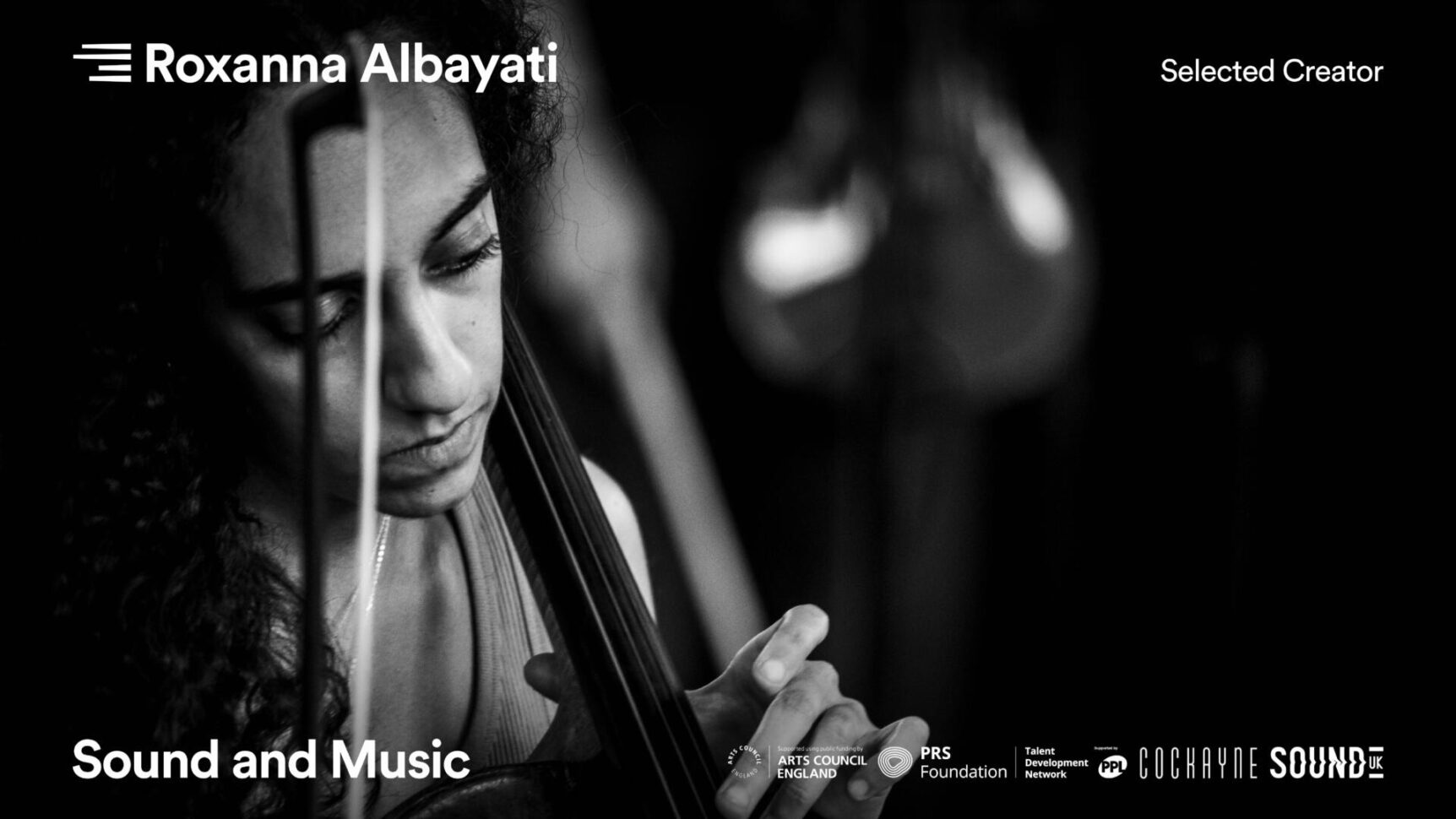
In this Q&A, we speak to In Motion 2026 creator Roxanna Albayati, an Iranian-Iraqi interdisciplinary artist, researcher and music educator. Driven by embodied artistic research, her transcultural practice centres around combining experimental music with multilingual art forms and audio-visuals, where her music merges cross-cultural improvisation with Persian Dastgah and the physicality of performance.
She is a tutor of Improvisation at Trinity Laban Conservatoire, and the Founder and Artistic Director of Displaced – a concert series which brings artists and audiences together through interdisciplinary storytelling and collective memory. Her latest work, Tavalode Dobare (Reborn), is a a transcultural AV work, merging Persian, Sicilian & Sufi poetry, music & ritual practice.
How would you describe your creative process?
I’m driven by embodied artistic research, where I use myself as a medium to process both personal and wider questions. I specifically use a/r/tographic research, which considers your positionality as an artist, researcher and teacher; for me, I take this as a free flowing 360 view of life, feeding into my artistic practice, where my fascination of process and natural evolution of discovery is key.
“I’m driven by embodied artistic research, where I use myself as a medium to process both personal and wider questions.”
Are there any particular themes, ideas or questions that you find yourself returning to in your work?
In the past 6 years I’ve explored the concept of belonging and home a great deal, but in the recent years I’ve found myself shifting focus to the sense of collective and personal grief. Wherever my focus lies, I’m always considering my explorations through the conscious/subconscious and self/other, interrogating their interplay internally, spiritually & materially.
What’s a piece of advice you’ve received that’s stuck with you?
‘Everything happens for a reason’ – from my mum. I take this with me everywhere, especially when I accidentally lose hours of recording material…
“In the past 6 years I’ve explored the concept of belonging and home a great deal, but in the recent years I’ve found myself shifting focus to the sense of collective and personal grief.”
Has your background, identity or environment influenced your sound or practice in any particular ways?
My heritage and generational movements both hugely influence my work. As an Iranian-Iraqi women, brought up in the UK, my music and spiritual practices take root in my heritage, whilst my Western training creates a further layer of support. I consider all themes through the perspective of Orientalist constructions and female place in societies, whether regarding purely music projects, or ones including other disciplines.
“My heritage and generational movements both hugely influence my work. As an Iranian-Iraqi women, brought up in the UK, my music and spiritual practices take root in my heritage, whilst my Western training creates a further layer of support.”
What’s your relationship with improvisation, and how does it shape your work?
It is the beginning and the end of my work, it’s my ‘high risk comfort zone.’ After years of interrogating the practice of free improvisation both in a musical setting and generally in life, I swear by the mindset and act of improvisation being the only genuine way I can create meaningful work for myself and the outer world. It allows me to begin without preconceptions, continue without judgement and end a work with an open heart for what is to come.
Are there any communities—online or offline—that have been important to your development as an artist?
The Abastan community in Tumanyan (Armenia) is greatly important to me, as well as generally the county of Armenia – it has taught me huge amount about self-preservation and discovery, allowing me to process my large amount of energy concerning this, where your sounds and expression become displaced, left in various corners of the world. Having travelled to Armenia multiple times, supported by the web of Abastan artists, each time is different, but every time through a collective passion for creation, you feel anything is possible.
The free improvisation network of musicians in Sicily is another community I owe a great deal. Through countless opportunities and appreciation for free expression, with them I feel my innate need to merge music traditions has truly developed.
“During In Motion I plan to dedicate my time to music traditions and voices which have in the past, or could in the future, run the risk of being lost – specifically pre-dastgāh Persian maqam and female voices in Sicilian Cantu.”
What are you looking forward to most about In Motion?
During In Motion I plan to dedicate my time to music traditions and voices which have in the past, or could in the future, run the risk of being lost – specifically pre-dastgāh Persian maqam and female voices in Sicilian Cantu. In the past years I’ve found these traditions both purposefully and subconsciously merging ‘transculturally’ in my practice. I’m thrilled to now have a project, which I can intentionally weave these sounds more tightly into my work, through my personal connections to these worlds and communities.

Sound and Music is a PRS Foundation Talent Development Network Partner supported by PPL.
In Motion 2026 is made possible with the generous support of Arts Council England. PRS Foundation, The Cockayne Foundation and Sound UK.
Learn more about Roxanna Albayati
Meet the In Motion 2026 creators
Learn more about In Motion