





In Motion is our transformative 18-month artist development programme for original music creators at pivotal points in their careers. We support music creators to design and embark on the next chapter of their creative and professional journey, providing the space, personalised support, funding, networks and skills development to realise their ambitions, culminating in a final creative project for public release.
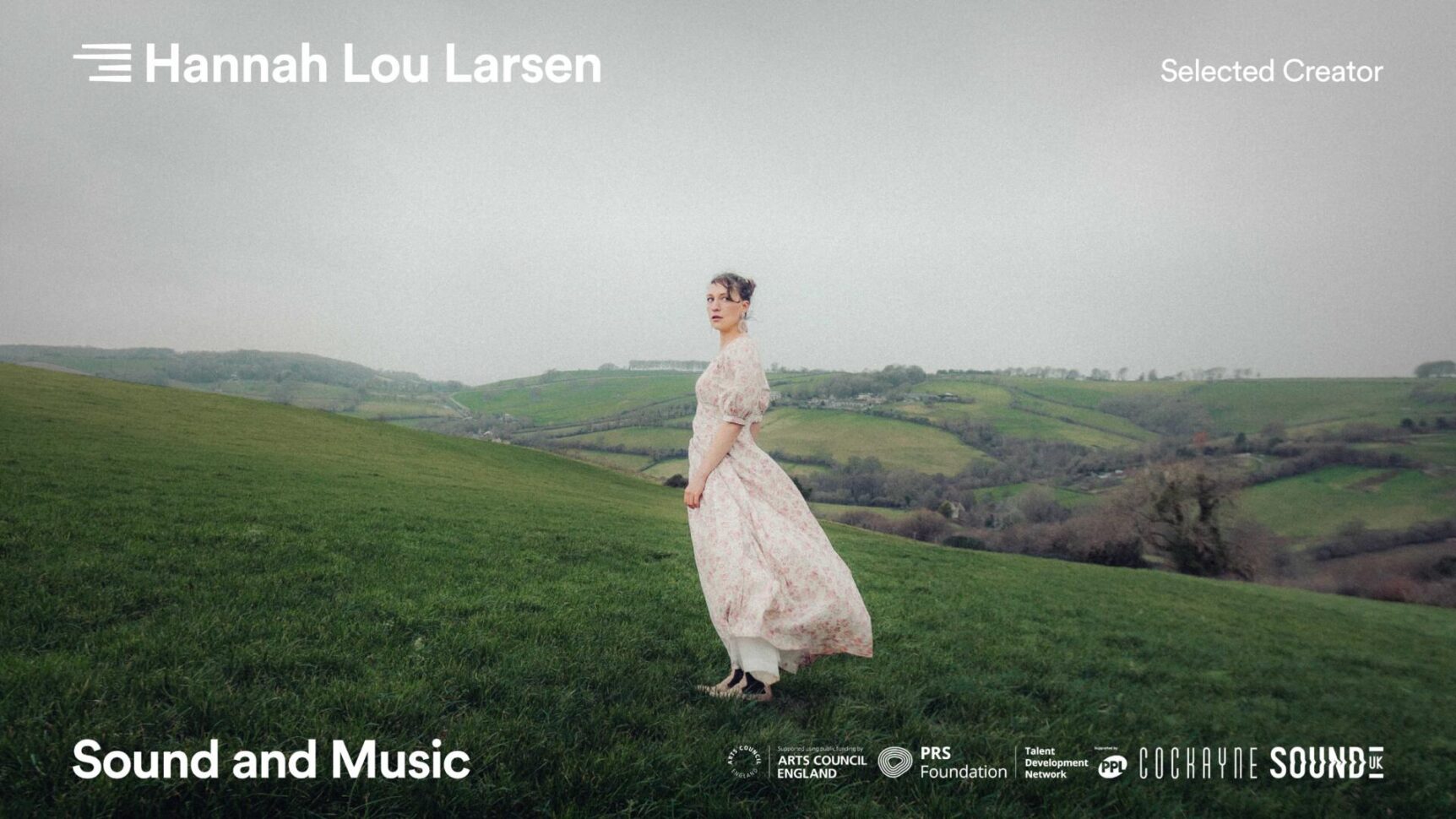
In this Q&A, we speak to In Motion 2026 creator Hannah Lou Larsen, a Danish Oxford-based composer and multi-instrumentalist. First drawn to music by overwriting cassette tapes of church sermons with a hairdryer and her brother’s asthmatic breathing, her solo show Pigeons in Transit sold out at Offbeat Festival 2024, and Before the Ashes Lose Their Leaves has featured at Radiophrenia and XMTR Fest.
Her EPs Lost Astronaut (2015) and Things We Learned to Live With (2019) aired on Danish National Radio and BBC6. Commissions include Voices of Exmoor and Freedom of Mind Community Choir. Her latest EP Peach Pine Ocean (2026) grew from her Boundary Encounters residency at Modern Art Oxford.
Has your background, identity or environment influenced your sound or practice in any particular ways?
I’ve always been hyper-aware of the tiny details of my surroundings – the sounds, the smells, the patterns and shapes that surround me. As a child I used to collect tiny objects and found treasures in a shoebox, and I would record the sounds of my everyday environment: my brother’s asthmatic breathing, the sound of a hairdryer, the creak of our squeaky floorboards in my childhood home. This is how I made sense of the bigger picture, I think. It’s still how I make sense of my world now, and this shapes my music. I think there is a huge richness in being a permeable being, a porous creature who is open to the world. And if you know your values and are grounded in something good, something sustainable, I like to think that this openness is my rebellious act against a world of AI, and profit-driven markets: to insist on being soft, on being a human in community with the world around me. This is how my sound has been shaped by the ebb and flow of the North Sea, the melodies of my dad’s humming in the morning as he opened the windows and how my voice feels like a continuous translation of every experience that moves through me.
“I like to think that this openness is my rebellious act against a world of AI, and profit-driven markets: to insist on being soft, on being a human in community with the world around me.”
What’s a sound you’ve heard recently that fascinated you?
I’ve been continually fascinated by the low, throaty coo of rock pigeons. For me, it’s the sound of waking late on a summer holiday morning at my grandparents’ house in Northern Denmark — both nostalgic and comforting. Yet it’s also an ancient sound, tied to the wild rock doves that once nested on cliffs before humans domesticated them over 5,000 years ago for food and communication. My great-grandfather was even a renowned homing pigeon judge. That deep curiosity about pigeons — their voices, histories and entanglement with us — eventually became the basis for my solo show Pigeons in Transit, which I’m excited to be touring this summer, since it first premiered at Offbeat Festival 2024.
What does collaboration mean to you, and how do you approach working with others?
Collaboration, to me, can mean many things. As a composer, I thrive on working with others — I’m never creating in a vacuum. My work always responds to a setting or a physical space, sometimes in harmony with it and sometimes in gentle defiance. This often takes the form of site-specific projects using foraged sounds — the wind singing through fences, a train rumbling in the distance, or the water’s pulse at Wolvercote Lakes in my headphone walk piece Before the Ashes Lose Their Leaves. The more familiar kind of collaboration is the creative exchange that happens when artists come together. I’ve learned so much from the musicians I’ve had the privilege to work with over the years. There’s deep value in meeting artists shaped by traditions different from your own. At times, this can mean a bit of confusion in the rehearsal room — learning to find common ground, adapt to new languages, or merge approaches from notation to improvisation — but that’s exactly where discovery happens. Whether collaboration feels effortless or challenging, it always teaches you something and leaves its mark.
“I’m looking forward to the rare opportunity to delve deeper into creative research. As a composer, the playful phase of experimenting, investigating, discovering new sounds, and forging untrodden paths is what makes my artist’s heart beat the strongest.”
What are you looking forward to most about In Motion?
I’m looking forward to the rare opportunity to delve deeper into creative research. As a composer, the playful phase of experimenting, investigating, discovering new sounds, and forging untrodden paths is what makes my artist’s heart beat the strongest. Ironically, there’s rarely enough time or freedom to linger there long enough for new work to grow deep roots. I believe that to create work with longevity, resonance, and impact, sustained periods of research and exploration are essential.

Sound and Music is a PRS Foundation Talent Development Network Partner supported by PPL.
In Motion 2026 is made possible with the generous support of Arts Council England. PRS Foundation, The Cockayne Foundation and Sound UK.
Learn more about Hannah Lou Larsen
Meet the In Motion 2026 creators
Learn more about In Motion